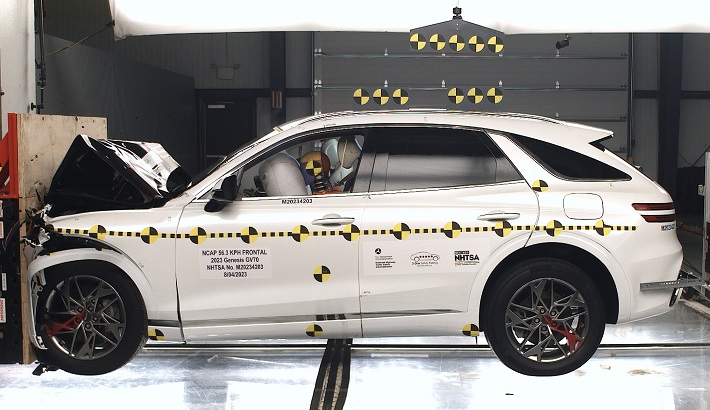
Open safety recalls, the components owners report failing most often, crash-test results and running costs for the 2025 Genesis GV70, assembled from NHTSA and EPA records.
One specific car
Checking one Genesis GV70?
Everything on this page applies to the model as a whole. Run its VIN to decode that exact car, its engine, trim, assembly plant and factory equipment, alongside these records.
Recalls and complaints are filed against a specific model year, so figures differ from one year to the next even within a single generation. See every Genesis GV70 year.
EPA fueleconomy.gov
Fuel economy and running cost
No match
No EPA fuel-economy match for this model. Naming may differ, or it predates EPA records.
NHTSA lists 2 recalls for this make, model and year. Recalls apply to the model, so some may already be fixed on this specific car. A dealer can confirm from the VIN.
Issue: Hyundai Motor America (Hyundai) is recalling certain Genesis 2023-2024 G80, GV80, 2025 GV70 and 2023-2025 GV70 "Electrified" vehicles. Due to a software error, the instrument panel display may fail. As such, these vehicles fail to comply with the requirements of Federal Motor Vehicle Safety Standard (FMVSS) number 101, "Controls and Displays."
Risk: An instrument panel display that fails to show critical safety information, such as the speedometer or warning lights, increases the risk of a crash.
Remedy: Dealers will inspect and update the instrument panel display software, as necessary, free of charge. Owner notification letters were mailed March 26, 2025. Owners may contact Genesis customer service at 844-340-9741. Hyundai's number for this recall is 026G.
Campaign 25V105000
FUEL SYSTEM, GASOLINE:DELIVERY:HOSES, LINES/PIPING, AND FITTINGS10/04/2026
Issue: Hyundai Motor America (Genesis) is recalling certain Genesis 2022-2026 GV70, 2023-2025 G90, 2021-2025 G80, and GV80 vehicles. Fuel may leak at the pipe connection between the fuel pipe and fuel rail.
Risk: A fuel leak increases the risk of a fire.
Remedy: Dealers will inspect and tighten, or replace the fuel pipe as necessary, free of charge. Owner notification letters were mailed beginning July 20, 2026. Owners may contact Genesis customer service at 844-340-9741. Genesis' number for this recall is 033G. Vehicle Identification Numbers (VINs) involved in this recall became searchable on NHTSA.gov beginning April 11, 2026.
As I’m getting on XXX south my dashboard starts to blackout on and off and the next thing, my vehicle shutdown. Luckily I was in traffic at a slow speed. It was very scary, I turned the engine back on and continued home to [XXX]. INFORMATION REDACTED PURSUANT TO THE FREEDOM OF INFORMATION ACT (FOIA), 5 U.S.C. 552(B)(6)
LANE DEPARTURE,FORWARD COLLISION AVOIDANCE09/07/2026
The instrument cluster display intermittently showed a number components in alarm state such as lane departure, collision warning, blind spot warning, ABS while driving and while parked then seemed to clear and go back to normal . There was no indication of a problem wi09th steering or braking.
ELECTRICAL SYSTEM09/04/2026
Had the update on the cluster, the infotainment system with go black or lag at random times
STEERING,POWER TRAIN,ELECTRICAL SYSTEM09/03/2026
Vehicle has physically and forcibly moved both forward and backward, on its own, after being placed in Park and the engine turned off — including after occupants have exited the vehicle. This movement has struck the driver and two minor children on multiple separate occasions, as well as nearby curbs and objects, without physical injury. No warning lamps or dashboard messages appeared before or during these incidents. Because the movement occurs after occupants have exited the vehicle, it is unknown how many additional times this may have occurred unobserved. Dealer states it was unable to duplicate this condition during a test drive. During this same visit, the right front CV axle was found to be leaking grease and had lost lubricant, and required full replacement. Both front horns were also found inoperable/defective due to internal short and were replaced. Neither of these conditions had been previously reported as faulty prior to this visit. Separately, this vehicle has experienced a steering column defect. At approximately 9,000 miles, a steering wheel squeak was reported and a dust cover was replaced. During that same earlier visit, an intermittent loss of acceleration was also reported; the dealer was unable to duplicate this concern and documented the vehicle as “operating as designed.” Weeks after that visit, a knocking noise developed in the steering column. At approximately 10,000 miles, a technician found a structural through-bolt in the steering column not torqued to manufacturer specification and corrected it. Dealer advised in writing that this defect was likely present at the time of manufacture. The vehicle has been taken to an authorized dealer on multiple occasions for these concerns. The owner has repeatedly requested, in writing, a detailed explanation of what was diagnosed, what was repaired, and the underlying cause of the movement, the axle failure, and the horn failure, and has not received a substantive written response as of this filing
BACK OVER PREVENTION,FORWARD COLLISION AVOIDANCEcrash08/28/2026
On XXX, I was taking my Genesis GV70 out of the garage, while going reverse the car would not stop, the car’s reverse parking collision-avoidance assist did not work, the car continued by going over my mailbox, crossed the street, went over a cable box, went up the hill and stopped by taking a tree out of the ground. The car was pronounced total loss by Geico. Geico’s claim # XXX. The car is now at Copart, phone # [XXX], [XXX], lot # XXX. I have opened up a case with Genesis to have the car inspected by a professional to find out malfunctioning of the rear collision avoidance assist. I had to pressure Genesis to hire a professional to inspect the car but they are taking an enormous amount of time to get back to me with an explanation. INFORMATION REDACTED PURSUANT TO THE FREEDOM OF INFORMATION ACT (FOIA), 5 U.S.C. 552(B)(6)
This supplements my prior complaint, ODI #11751961, for the same vehicle. Following that complaint, an authorized dealer performed front camera and front radar ADAS calibration on 7/21/2026 and returned the vehicle as operating as designed; the manufacturer's representative confirmed in writing on 7/22/2026 that the camera had been within specification. On 7/23/2026, approximately 1:21–1:35 PM, driving in the left lane of a divided parkway with a concrete median barrier, with HDA2 and Lane Following Assist both active and indicating green, the steering wheel turned the vehicle toward the concrete barrier at least seven times, requiring manual correction each time. This occurred both with a lead vehicle approximately 4 seconds ahead and with no vehicle within more than 10 seconds ahead. Earlier the same day, driving the opposite direction with both systems active and green, the vehicle applied hard automatic braking twice with no vehicle within more than 10 seconds ahead (traffic present only in the adjacent lane); I had to manually accelerate because a following vehicle was close behind. My original complaint reported the automatic braking failing to activate; the system now also activates falsely. Additionally, the hands-on-wheel warning repeatedly illuminated while my hands were on the wheel, taking approximately 30 seconds to detect them. I have stopped driving the vehicle. The manufacturer was notified in writing the same day, and a second repair visit is being arranged. No crash or injury has occurred.
When Highway Driving Assist / Lane Following Assist is active — confirmed by illuminated green HDA and lane assist indicators — the vehicle applies uncommanded steering torque, to the left or to the right, strong enough to force the vehicle out of its lane. This occurred on every drive, daily, from delivery on 7/2/2026 (approximately 23,200 miles) until the vehicle was brought in for service on 7/13/2026. The behavior was identical regardless of lane markings (solid, dotted, or absent) and road geometry (straight or curved), at highway speed and on local roads at approximately 30 mph. On multiple occasions the vehicle was pushed toward highway barriers (concrete median and metal guardrail, on both left and right sides) and into the oncoming traffic lane; avoiding barrier contact or returning from the oncoming lane required forceful manual correction, during which the rear of the vehicle oscillated side to side before directional control was fully regained. This occurred regardless of speed. Separately, the forward collision-avoidance / automatic emergency braking system failed to activate on multiple occasions when approaching stopped or slowing traffic, requiring hard manual braking by the driver. No warning lights displayed. An authorized dealer inspected the vehicle 7/13–7/21/2026: scans found no stored diagnostic trouble codes, road tests did not reproduce the behavior, and the dealer performed front camera and front radar ADAS calibration on 7/21/2026. I am currently monitoring the vehicle to determine whether the calibration corrected the behavior. A comparable loaner vehicle of the same brand exhibited correct HDA/LFA operation, which is how I confirmed my vehicle's behavior is abnormal. No crash or injury has occurred.
ELECTRICAL SYSTEM,UNKNOWN OR OTHER07/15/2026
Back-up camera stopped working. Upon Reverse, a green screen appears that says "No Camera Signal Received. Please try again later". Green screen disappears when car is put in Drive. Issue did not correct itself upon on/off cycle. Car will be taken into dealer for repair.
UNKNOWN OR OTHER07/08/2026
On June 8, 2026, while driving home from work and actively entering the freeway, the vehicle experienced a sudden, severe, and catastrophic loss of propulsion. Despite pressing the accelerator, the vehicle completely refused to accelerate beyond 30 mph, forcing me to navigate active highway traffic at a dangerously low speed. This sudden failure to accelerate while merging onto a high-speed interstate created an immediate, life-threatening situation, leaving the vehicle highly vulnerable to a severe rear-end collision. The vehicle was towed to an authorized Genesis dealership on June 9, 2026. Genesis Motor America (GMA) corporate customer service was notified, and Case #42801757 was opened. On June 25, 2026, the dealership stated they performed code scans and test drives but could not replicate the intermittent symptom or find any stored fault codes, declaring the vehicle ready for pickup without identifying or correcting the root cause of this severe defect. When challenged on the phone regarding the severe safety risk of driving a vehicle that unpredictably loses highway propulsion, the service advisor dismissed the life-threatening concern as "hypothetical." On July 3, 2026, GMA Customer Service provided their assessment on Case #42801757, rigidly stating the vehicle is not eligible for Lemon Law relief and instructing me to follow the dealer's advice to pick up the un-repaired car. Genesis is actively using the threat of immediate loaner car charges to force an unsafe vehicle back onto public roads. I am uploading the full email correspondence as evidence that Genesis corporate is forcing a vehicle with an unaddressed, life-threatening propulsion failure back into service.
ENGINE07/02/2026
Auto Start Stop seemed to have malfunction and shut the car off completely. I had to restart the car in traffic to get going. This happened twice, once going to work and once on a weekend trip to New Jersey. The only thing that's preventing an accident is you have to stop for the auto start feature to even activate.
FUEL SYSTEM, GASOLINE06/30/2026
The contact owns a 2025 Genesis GV70. The contact received notification of NTHSA Campaign Number: 26V229000 (Fuel System, Gasoline); however, the part to do the recall repair was not yet available. The local dealer was contacted. The contact stated that the manufacturer had exceeded a reasonable amount of time for the recall repair. The manufacturer was not made aware of the failure. The contact had not experienced a failure.
POWER TRAIN,ENGINE06/17/2026
My 2025 Genesis GV70 stopped accelerating properly. There is a lag when you push on the accelerator pedal and it must be pushed about 75% before it begins to accelerate. When it does accelerate it has much less power than normal. This fault occurs constantly. The car can't accelerate normally at any time now. This is definitely a very serious safety hazard. This behavior has been reproduced by Genesis service personnel. There are no warning lights associated with the problem and no diagnostic codes are signaled. After 24 days the Genesis service personnel have no idea what is wrong.