2017 Toyota Corolla Recalls, Problems and Common Complaints · Vinqua
2017 Toyota Corolla
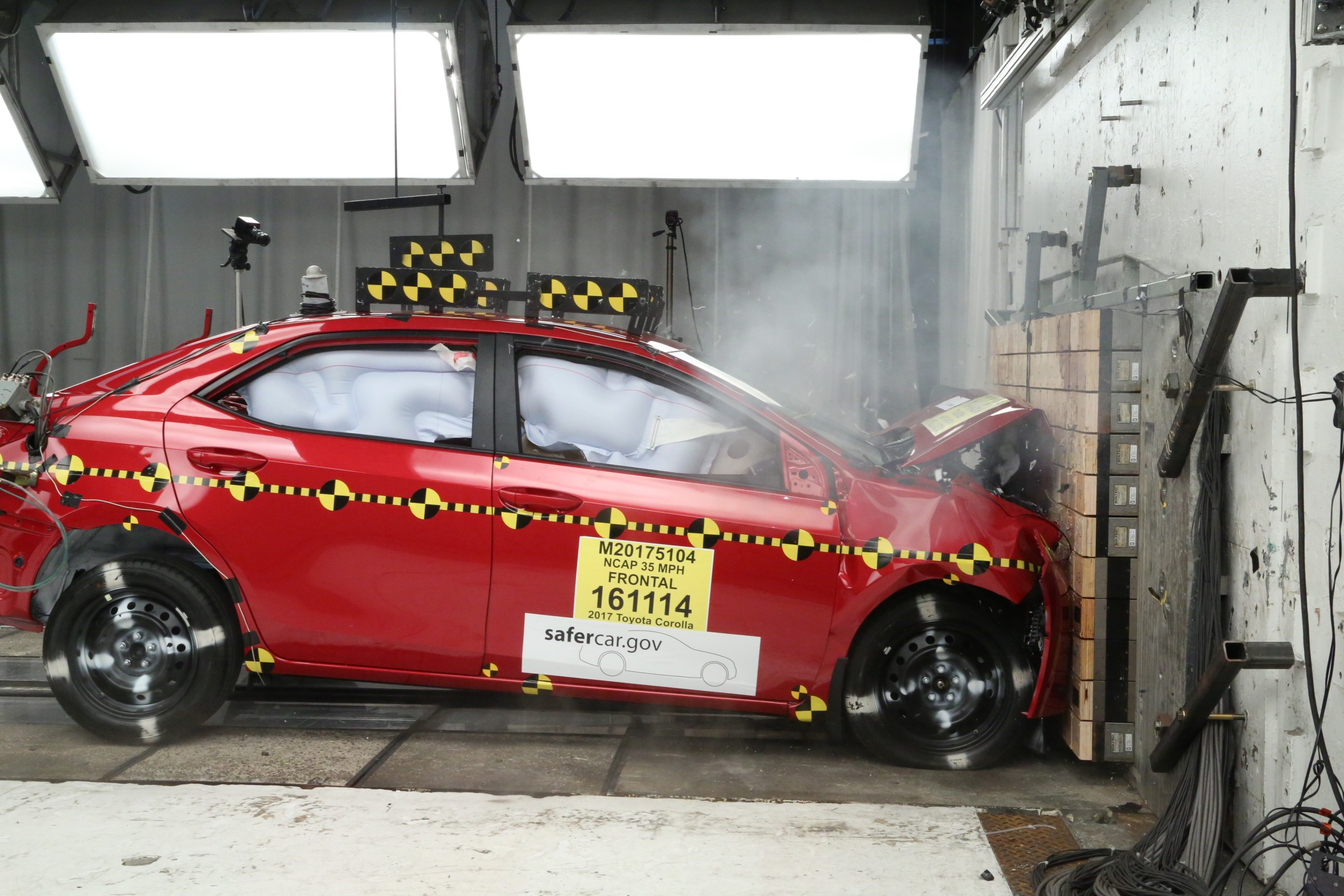
Open safety recalls, the components owners report failing most often, crash-test results and running costs for the 2017 Toyota Corolla, assembled from NHTSA and EPA records.
One specific car
Checking one Toyota Corolla?
Everything on this page applies to the model as a whole. Run its VIN to decode that exact car, its engine, trim, assembly plant and factory equipment, alongside these records.
Recalls and complaints are filed against a specific model year, so figures differ from one year to the next even within a single generation. See every Toyota Corolla year.
EPA fueleconomy.gov
Fuel economy and running cost
31 mpg
28mpg
City
31mpg
Combined
35mpg
Highway
Over 5 years this costs $1,000 less in fuel than an average new vehicle.
NHTSA lists 3 recalls for this make, model and year. Recalls apply to the model, so some may already be fixed on this specific car. A dealer can confirm from the VIN.
AIR BAGS: AIR BAG/RESTRAINT CONTROL MODULE17/01/2020
Issue: Toyota Motor Engineering & Manufacturing (Toyota) is recalling certain 2011-2019 Corolla, 2011-2013 Matrix, 2012-2018 Avalon, and 2013-2018 Avalon Hybrid vehicles. During certain crashes, the air bag electronic control unit (ECU) may malfunction, possibly disabling the deployment of the air bags and/or seat belt pretensioners.
Risk: In the event of a crash, air bags and/or seat belt pretensioners that do not deploy as intended may increase the risk of injury.
Remedy: Toyota will notify owners, and dealers will inspect the ECU and install a noise filter between the air bag control module and its wire harness, as necessary, free of charge. Owners were notified of the safety risk beginning March 2, 2020. A second letter notifying owners of the remedy repair will be mailed between March 16, 2020 and June 27, 2020. Owners may contact Toyota customer service at 1-888-270-9371. Toyota's numbers for this recall are 20TB03, 20TA03 and 20TA05.
Campaign 20V024000
EQUIPMENT:OTHER:LABELS28/06/2019
Issue: Southeast Toyota Distributors, LLC (SET) is recalling certain 2017-2019 Toyota Camry, Corolla, Rav4, Sienna, and Yaris iA vehicles equipped with factory-installed floor mats. The load carrying capacity modification label may be incorrect. As such, these vehicles fail to comply with the requirements of Federal Motor Vehicle Safety Standard (FMVSS) number 110, "Tire Selection and Rims."
Risk: An incorrect label may lead to unintentionally overloading the vehicle, increasing the risk of a crash.
Remedy: SET will notify owners and provide a corrected label for placement over the inaccurate label, free of charge. The recall began August 23, 2019. Owners may contact Toyota customer service at 1-888-270-9371. SET's number for this recall is SET19A.
Campaign 19V503000
TIRES:TEMPORARY/EMERGENCY SPARE TIRE02/05/2017
Issue: Gulf States Toyota, Inc. (Gulf States) is recalling certain 2017 4Runner , 86, Avalon, Camry, Camry Hybrid, Corolla, Corolla iM, Highlander, Highlander Hybrid, Prius, Prius C, RAV4, RAV4 Hybrid, Sienna and Yaris vehicles. The spare tire air pressure was not adjusted to the proper pressure as stated on the Tire Pressure Label.
Risk: A spare tire that is not inflated to the proper value may not perform as intended, increasing the risk of a crash.
Remedy: Gulf States will notify owners, and dealers will inspect the spare tires, adjusting their pressure as necessary, free of charge. The recall began June 15, 2017. Owners may contact Gulf States customer service at 1-800-444-1074. Toyota's number for this recall is 17R2.
The contact owns a 2017 Toyota Corolla. The contact stated that while the vehicle was at an independent mechanic for brake service, the contact was informed that the transmission chain had fractured and needed to be replaced. The vehicle was towed to another independent mechanic for the transmission to be replaced. The vehicle was not yet repaired. The manufacturer was made aware of the failure and advised the contact to file a complaint with the NHTSA Hotline. The failure mileage was approximately 111,000.
UNKNOWN OR OTHER,ENGINE,FORWARD COLLISION AVOIDANCE07/23/2026
While driving in the middle of active traffic, the vehicle experienced a sudden and dangerous loss of motive power. The first indication of a problem was the A/C abruptly blowing hot air. Immediately following this, the vehicle began violently shaking before the engine stalled completely. The low oil pressure warning light was triggered on the dashboard. Losing all acceleration in the middle of active traffic created an immediate, severe crash hazard. The engine failure occurred after a franchised dealer service department failed. They had said at the dealership that my oil was fine. They didn’t even check it.
AIR BAGS,BACK OVER PREVENTION,FORWARD COLLISION AVOIDANCE06/14/2026
My 2017 Toyota Corolla is Involved in Illegal Airbags that Are A Horrible CRASH RATING F - by .Toyota of Spartanburg South Carolina in 3 Recall To the Owner of 2017 Toyota Certified Pre Owned USA Automobile The NTSA Has Multiple Auto Manufacturing Companies that Are CHINESE AIRBAGS That ARE UNSAFE AND CAN DEPLOY and HURT PASSENGERS and ALLSTATE AUTO INSURANCE WILL TEST SAFE USA AIRBAGS for My TOYOTA USA SEDAN To INSURE CAR AUTO SAFETY
AIR BAGS04/17/2026
My2017 Toyota Corolla was Purchased at Dave Edward’s Certified Pre Owned Car Dealer in Spartanburg South Carolina in 2018 It has Multiple Recall Notices by Toyota USA on ILLEGAL FACTORY INSTALLED CHINESE AIR BAGS THAT SHOULD NOT HAVE BEEN IN TOYOTA USA AUTOMOBILES BY INFERIOR DESIGN AND POOR QUALITY ALARM FAILURE THIS SPARTANBURG TOYOTA DEALERSHIP IS INVOLVED IN A NATIONAL CRISIS OF AIR BAG ILLEGAL RECALL SAFETY ASSAULT ON CONSUMER CONFIDENCE KEITH C CUTLER OWNER OF 2017 TOYOTA COROLLA CAYENNE RED AUTOMOBILE
AIR BAGScrash03/15/2026
While I was driving in the middle lane through an intersection, a car from the opposite side failed to yield while turning and hit me on my driver's side. My car was traveling at approximately 35 MPH, and the other vehicle was exceeding the speed limit. The impact caused my car to veer in the opposite direction and I lost consciousness immediately. The fire department had to extract me from the passenger side door as my driver's side door was jammed shut. Both the driver's door and the rear door on that side cannot be opened, rendering the car undriveable and necessitating towing from the crash scene. The collision was severe, causing my head to snap back and forth against the steering wheel, along with impact to the left side of my body and whiplash to my neck, back, and chest. I was taken to the nearest ER by ambulance, experiencing bruises as well as severe pain in my head, neck, back, and chest, making breathing difficult. Despite the intensity of the crash, the airbags did not deploy, leading to further jolting of my body against the car interior. I had bought the car directly from a Toyota dealer, but I have not been contacted by Toyota regarding any potential manufacturing defects. The failure of the airbags to deploy after such a significant impact and the speed of the other vehicle has raised concerns about the safety of my car, as I was under the impression that it was free of defects.
While reversing out of a parking spot, I noticed my break and steering wheel felt extremely stiff. I lost control of the vehicle for a second until I instinctively pushed HARD on the break. I realized it was unsafe to continue reversing, so I switched from R (reverse) to D (drive), I let go of the break pedal slowly, but the car continued to reverse. I pushed hard on the stiff break again, and switched from D (drive), to P (park), I let go of the break pedal again, and the car continued to roll back in reverse still. I realized my cars breaks, steering wheel, and gears were being unresponsive. I kept my foot on the break pedal, used the parking stick and set the car into P (parking) again, and turned it off. The car did not roll back as before, and was completely off. I turned the car back on again, and it went back to normal. The steering wheel and break pedal were not stiff, and the gears were all working and being responsive. I searched up the problem, and from what I have read, it is currently unsafe to drive my vehicle. I have kept up with proper and regular maintenance on my vehicle. But from what I have researched, the corolla has had a massive recall on this exact problem. However, my vin number indicates my vehicle is not eligible for a recall. I would like to receive proper help for this problem, as it is a dangerous and widely known problem with the 2013-2019 corollas.
AIR BAGScrash02/10/2026
While driving approximately 35–45 mph, my vehicle struck a deer in a frontal collision. The impact resulted in significant front-end damage and the vehicle was later declared a total loss. The airbags did not deploy. At the time of the crash, the vehicle was subject to an unrepaired federal safety recall involving the airbag control unit (ZF-TRW ACU recall). I experienced soreness following the crash. No airbags deployed.
ELECTRICAL SYSTEM01/30/2026
Odometer Fraud. The contact purchased a 2017 Toyota Corolla. The contact discovered that there was a mileage discrepancy after the purchase. The vehicle was an independent dealer sale. At the time of purchase, the vehicle mileage was 100,534. It was later discovered upon checking the Carfax Report, that the mileage was 112,085.
SUSPENSION,SERVICE BRAKES01/11/2026
I am contacting you on a problem I cannot fully describe. However, I believe there is a mechanical problem with the right side of my vehicle with handling and braking. I have downloaded the form with the information as reported to me and explained via the North American Corolla Facebook group. Please look at the attached documentation.
ELECTRICAL SYSTEM,AIR BAGS,SEAT BELTS11/26/2025
The contact owns a 2017 Toyota Corolla. The contact stated while driving at an undisclosed speed, the air bags and seat belt warning lights were illuminated. The contact stated that upon starting the vehicle, the air bags and the passenger's side seat belt warning lights illuminated. The contact stated that the front passenger's side seat was not occupied. The vehicle was taken to an unknown dealer, where the contact declined to pay a diagnostic fee because the failure was a safety issue. The vehicle was not diagnosed or repaired. The contact stated that the front passenger's side air bag and the dashboard were replaced in 2022, and the front driver's side seat belt was replaced in 2023. In addition, the wiring harness was replaced due to water intrusion in March 2022. The contact was informed that the repair was not covered under warranty, and the 12 months warranty had expired. The manufacturer was not made aware of the failure. The failure mileage was approximately 13,369.
ENGINE,FORWARD COLLISION AVOIDANCE10/16/2025
When the cruise control is set and I go down hill my car increases the speed by 8 mph faster than the set speed. My car also makes a loud grinding noise when it does this. I spoke with different Toyota auto employees and some say that the increase in speed and noise are normal and others say the opposite. I have been in many cars driving with cruise control on and never experienced this.
LATCHES/LOCKS/LINKAGES09/03/2025
The contact owns a 2017 Toyota Corolla. The contact was unable to exit the vehicle after pulling on the driver’s side door handle. The contact made several attempts to exit the vehicle, but the door was jammed. Due to the failure, the contact was forced to exit the vehicle through front passenger’s side door. The contact was able to open the front driver’s side from outside only. The dealer and the manufacturer were notified of the failure, and both informed the contact that no assistance would be provided. The manufacturer referred the contact to the NHTSA Hotline to report the failure. The vehicle was not repaired. The failure mileage was 51,654.