Open safety recalls, the components owners report failing most often, crash-test results and running costs for the 2018 Toyota Corolla, assembled from NHTSA and EPA records.
Everything on this page applies to the model as a whole. Run its VIN to decode that exact car, its engine, trim, assembly plant and factory equipment, alongside these records.
Open a VIN recordRecalls and complaints are filed against a specific model year, so figures differ from one year to the next even within a single generation. See every Toyota Corolla year.
NHTSA lists 3 recalls for this make, model and year. Recalls apply to the model, so some may already be fixed on this specific car. A dealer can confirm from the VIN.
Issue: Southeast Toyota Distributors, LLC (SET) is recalling certain 2017-2019 Toyota Camry, Corolla, Rav4, Sienna, and Yaris iA vehicles equipped with factory-installed floor mats. The load carrying capacity modification label may be incorrect. As such, these vehicles fail to comply with the requirements of Federal Motor Vehicle Safety Standard (FMVSS) number 110, "Tire Selection and Rims."
Risk: An incorrect label may lead to unintentionally overloading the vehicle, increasing the risk of a crash.
Remedy: SET will notify owners and provide a corrected label for placement over the inaccurate label, free of charge. The recall began August 23, 2019. Owners may contact Toyota customer service at 1-888-270-9371. SET's number for this recall is SET19A.
Campaign 19V503000
Issue: Toyota Motor Engineering & Manufacturing (Toyota) is recalling certain 2011-2019 Corolla, 2011-2013 Matrix, 2012-2018 Avalon, and 2013-2018 Avalon Hybrid vehicles. During certain crashes, the air bag electronic control unit (ECU) may malfunction, possibly disabling the deployment of the air bags and/or seat belt pretensioners.
Risk: In the event of a crash, air bags and/or seat belt pretensioners that do not deploy as intended may increase the risk of injury.
Remedy: Toyota will notify owners, and dealers will inspect the ECU and install a noise filter between the air bag control module and its wire harness, as necessary, free of charge. Owners were notified of the safety risk beginning March 2, 2020. A second letter notifying owners of the remedy repair will be mailed between March 16, 2020 and June 27, 2020. Owners may contact Toyota customer service at 1-888-270-9371. Toyota's numbers for this recall are 20TB03, 20TA03 and 20TA05.
Campaign 20V024000
Issue: Toyota Motor Engineering & Manufacturing (Toyota) recalled certain 2018-2019 4Runner, Highlander, Camry, Land Cruiser, Sequoia, Sienna, Tacoma and Tundra, and Lexus RC 300, RC 350, GS 350, GX 460, IS 300, LC 500, LS 500, LX 570, RX 350L, and 2019 Toyota Avalon and Corolla, and certain Lexus NX 300, and ES 350 vehicles on January 13, 2020. On March 4, 2020, Toyota expanded the recall to include certain 2014-2015 Toyota 4Runner and Land Cruiser, 2018 Avalon, Corolla, 2014 FJ Cruiser, 2017 Sienna and Lexus 2018 ES 350, 2018-2019 GS 300, 2013-2014 GS350, 2014-2015 GX 460, IS 350 and LX 570, 2014 IS F, 2018-2019 IS 350, LC 500H and LS 500H, 2013-2015 LS 460, 2015 NX 200T and RC350, 2017 RC 200T and RX 350. Toyota also removed the 2018-2019 Toyota 4Runner and Land Cruiser and 2018-2019 Lexus GX 460 and LX 570 and 2019 NX300 from inclusion in this recall. On March 19, 2020, Toyota expanded the recall to include 2015 Lexus GS350 vehicles. The low-pressure fuel pump inside the fuel tank may fail.
Risk: If the fuel pump fails, the engine can stall while driving, increasing the risk of a crash.
Remedy: Toyota will notify owners, and dealers will replace the fuel pump, free of charge. The recall began May 4, 2020. Owners may contact Toyota customer service at 1-888-270-9371 or Lexus customer service at 1-800-255-3987. Toyota's numbers for this recall are 20TB02 and 20TA02 for Toyota vehicles and 20LB01 and 20LA01 for Lexus vehicles.
Campaign 20V012000
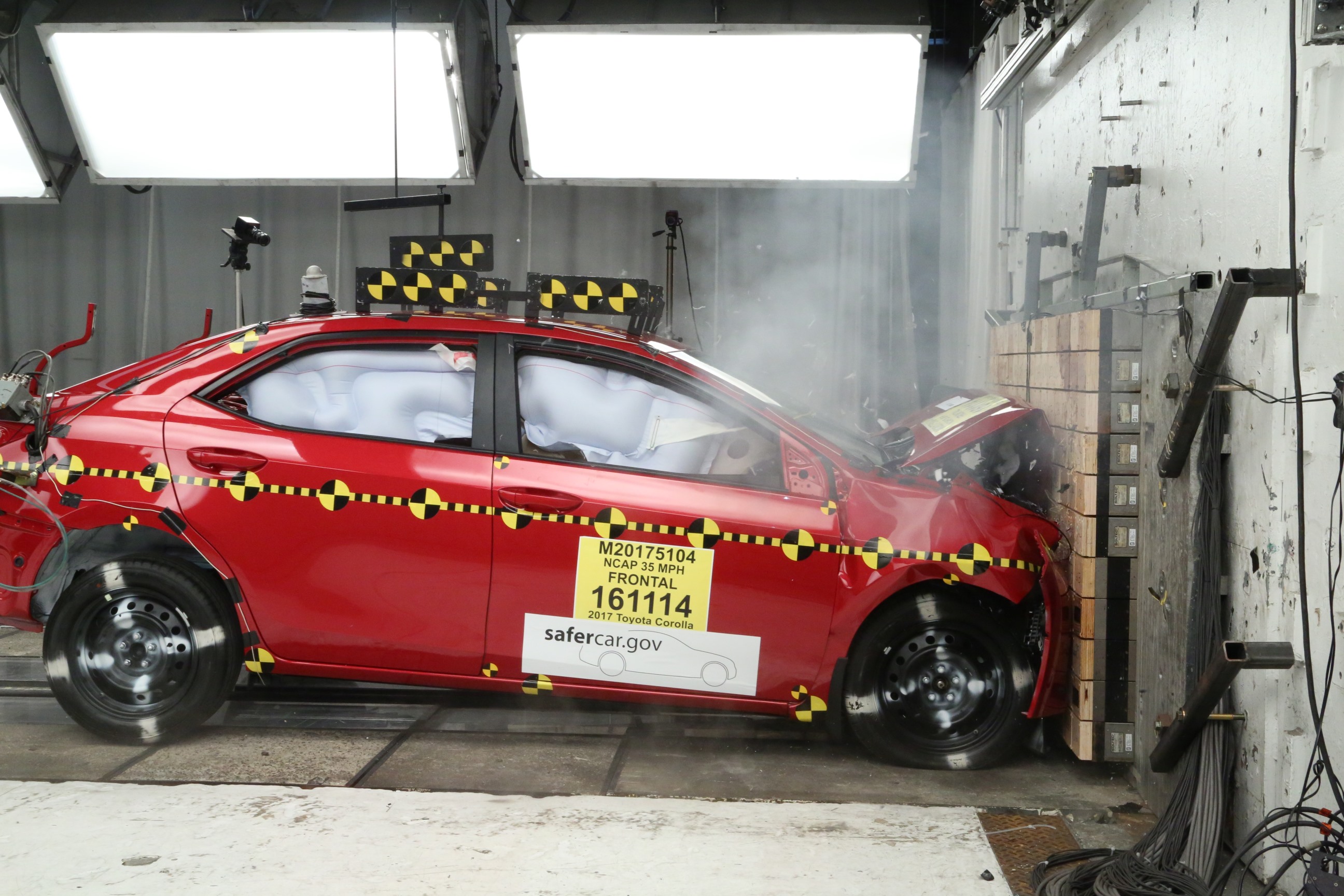
NHTSA frontal crash test
2 open NHTSA investigations into this model. Investigations come before recalls, so these are potential defects not yet covered by one.
Rated configuration: 2018 Toyota Corolla 4 DR FWD
The parts named most often across 133 owner complaints filed with NHTSA for this make, model and year.
14 crashes · 9 injured · 1 death
1 crash · 1 fire
1 fire · 1 injured
2 crashes · 2 injured
1 crash
1 injured
Complaints are self-reported and skew toward problems people find alarming, so read this as where to look rather than as a defect rate.
1 complaint-reported fatality on this model.
CV axle making clicking noise when turning with all CV axle boots in good condition.
Each travel driver seat belt become tight I try pull down for loose and I have notice the driver seat become level low.
The contact owns a 2018 Toyota Corolla. The contact stated that while driving 75 MPH, there was an abnormal whining sound coming from the vehicle, and the vehicle failed to accelerate while depressing the accelerator pedal. The contact stated that the tachometer was raised to high levels while exiting the highway. While at a stoplight, the vehicle hesitated while accelerating with the check engine warning light illuminated on the instrument panel. Due to the failure, the vehicle was towed to an independent mechanic. An OBD2 scanner was used to diagnose the vehicle, and DTC: P0741, P075B, P1604, P2757, P2820(X4) were retrieved, which were related to the torque converter. The contact was informed that the CVT transmission needed to be replaced, and the contact was provided with an estimate for the repair. The manufacturer was notified of the failure but denied any assistance. The vehicle was not repaired. The failure mileage was 76,099.
My 2018 Toyota Corolla has problems with acceleration and a very large noise in the front bar that guides the wheels. It also accelerates by itself, which is why I have had to change the brakes many times. It also shakes a lot at the bottom
Due to recent reports of fuel pump recalls, my daughter bought a 2018 Toyota Corolla almost a year ago. Right now that is problem and her car will not start. I need a free replacement of her fuel pump. Thank you.
On October 17, 2025, a 2018 Toyota Corolla LE was delivered to an authorized Toyota dealership for an airbag recall repair. The recall involved the airbag electronic control unit (ECU), which, according to Toyota and the National Highway Traffic Safety Administration (NHTSA), may fail to deploy the airbags and/or seatbelt pretensioners during certain types of crashes due to inadequate protection against electrical noise. The vehicle was picked up on October 18, 2025, after the dealer reported the recall repair as completed. Before the recall, the vehicle displayed a clear and consistent safety issue: the “Passenger Airbag OFF” indicator stayed illuminated even when a full-size adult occupant (approximately 208 lbs) was seated in the front passenger seat. After the recall repair, the exact same issue persisted with no improvement. The repair was ineffective, as the system still failed to recognize an occupied seat, and the passenger airbag continued to show “OFF.” When this was reported to the dealership immediately after pickup, staff incorrectly stated that the recall concerned metal fragments inside the airbags. This is inaccurate. The official recall documentation from Toyota and NHTSA clearly identifies the defect as non-deployment of airbags and seatbelt pretensioners, not metal fragments. The dealership then advised that a diagnostic inspection would be needed for a $175 fee. However, since this issue directly involves the same safety components addressed by the recall and remains unresolved after the recall repair, it should be re-inspected free of charge under recall coverage. Charging a diagnostic fee in this case is unreasonable, given that the recall repair did not correct the problem as intended. This ongoing malfunction presents a serious safety risk, as the airbag may fail to deploy in a crash. The problem likely involves a defective occupant detection sensor or an improperly functioning ECU/noise filter following the recall service.
After having no indication of any issue, my 2018 Toyota Corolla has stopped re-starting after fueling. The only light that appeared was regarding my battery. My battery is brand new and tested.
Odometer Fraud. The contact purchased a 2018 Toyota Corolla. The contact discovered a mileage discrepancy after the purchase. The vehicle was a private sale. At the time of purchase, the vehicle mileage was approximately 85,000. The contact later discovered that the mileage on the Title was 200,095.
CVT transmission is making a loud noise and undrivable due to jerking motion every time I accelerate.
My 2018 Toyota Corolla has ongoing fuel pump-related issues that mirror those in the official recall, yet my VIN is not included. Every time I refuel, my car shuts off and will not restart for 1–2 hours. I’ve brought the vehicle to five different mechanics, including two full inspections with electronic diagnostics—none could find a fault except one who identified the fuel pump as the likely cause. Even Toyota-certified dealerships could not determine the issue. Additionally, any time I drive over 70 mph, the car displays a message telling me to take a break, then it begins to jerk and drive erratically, clearly a safety hazard. This problem has occurred repeatedly and poses a serious risk of accident on the highway. This issue is widely reported among 2018 Corollas and matches symptoms from Toyota’s known fuel pump recall. I’m shocked that Toyota has refused a goodwill repair and won’t inspect it under the recall. If the fuel pump is failing, it puts drivers and passengers at serious risk of being stranded or worse—losing power at high speeds. Please investigate this and consider expanding the recall to cover more 2018 Toyota Corolla VINs before someone is injured or killed due to this known and dangerous defect.
The contact owns a 2018 Toyota Corolla. The contact stated while attempting to start the vehicle, or upon approaching a stop, the engine sounded very weak, almost as if the vehicle would shut off. The contact stated that the vehicle had shut off previously while driving through a drive thru. The vehicle was restarted, and the check engine warning light illuminated while driving. The contact also stated that after refueling the vehicle, the accelerator pedal had to be pumped while starting the vehicle. The vehicle was taken to a local independent mechanic to be diagnosed and DTC: P0171 was retrieved. The contact was informed that the EVAP valves and system were faulty and needed to be replaced. The vehicle was repaired; however, the failure persisted. The contact referenced NHTSA Campaign Number: 20V012000 (FUEL SYSTEM, GASOLINE) as possible cause for the failure. The manufacturer was notified of the failure. The approximate failure mileage was 85,750. The VIN was not available.
A whole new set of 4 tires were purchased and installed on the vehicle on 10/10/2024. While driving at highway speed 3 weeks later the rear driver side tire, in quick succession, went flat and almost instantaneously disintegrated causing the car to spin out and crash off the road. The car airbags deployed- saving the driver from injury or worse. Since the incident occurred out of home state and far from home and the car was totaled - it was sold as junked and not available for inspection. The accident could have involved other vehicles if the road was more crowded. Since only a single vehicle was involved - Maryland police would not write or provide a report. We believe that the tire failed on its own and wasn’t caused by an external object.
Showing 12 of 133 complaints.
Over 5 years this costs $1,000 less in fuel than an average new vehicle.