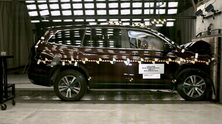
Open safety recalls, the components owners report failing most often, crash-test results and running costs for the 2016 Honda Pilot, assembled from NHTSA and EPA records.
One specific car
Checking one Honda Pilot?
Everything on this page applies to the model as a whole. Run its VIN to decode that exact car, its engine, trim, assembly plant and factory equipment, alongside these records.
Recalls and complaints are filed against a specific model year, so figures differ from one year to the next even within a single generation. See every Honda Pilot year.
NHTSA Recalls
Safety recalls
8 open
NHTSA lists 8 recalls for this make, model and year. Recalls apply to the model, so some may already be fixed on this specific car. A dealer can confirm from the VIN.
FUEL SYSTEM, GASOLINE:STORAGE30/03/2017
Issue: Honda (American Honda Motor Co.) is recalling certain 2016 Honda Pilot 2WD and AWD vehicles. The affected vehicles have fuel tanks that may leak.
Risk: A fuel leak in the presence of an ignition source can increase the risk of a fire.
Remedy: Honda will notify owners, and dealers will replace the fuel tank, free of charge. Owners may contact Honda customer service at 1-888-234-2138. Honda's number for this recall is KE8.
Issue: Honda (American Honda Motor Co.) is recalling certain model year 2015 Acura MDX 2WD and MDX 4WD vehicles, 2016 Acura MDX 4WD vehicles, 2015-2016 Honda Odyssey vehicles, and 2016 Honda Pilot 2WD and 4WD vehicles. The affected vehicles have fuel tanks that were manufactured with insufficient welds which may separate and allow fuel to leak out.
Risk: A fuel leak in the presence of an ignition source may result in a fire.
Remedy: Honda will notify owners, and dealers will replace the fuel tanks, free of charge. Owners may contact Honda/Acura customer service at 1-888-234-2138. The recall began on July 29, 2016. Honda's numbers for this recall are KA9 (Honda vehicles) and KB0 (Acura vehicles).
Campaign 16V417000
SEAT BELTS:REAR/OTHER06/07/2015
Issue: Honda (American Honda Motor Co.) is recalling certain model year 2016 Honda Pilot vehicles manufactured May 4, 2015, to June 5, 2015. Due to an assembly issue, the third row seatbelt may be trapped between the rear seat and the rear sideliner.
Risk: If the third row seatbelt is trapped, the occupants may not be restrained properly, increasing the risk of injury.
Remedy: Honda will notify owners, and dealers will inspect and repair the rear third row seat belt, free of charge. The recall began on August 6, 2015. Owners may contact Honda customer service at 1-310-783-2000. Honda's number for this recall is JS7.
Issue: Honda (American Honda Motor Co.) is recalling certain model year 2016 Honda Pilot 2WD vehicles manufactured May 4, 2015, to September 8, 2015 and 2016 Pilot 4WD vehicles manufactured May 7, 2015 to September 4, 2015. In the affected vehicles, when one of the safety systems such as tire pressure monitoring, anti-lock braking or electronic stability control malfunctions, there is potential that the instrument panel will not illuminate the corresponding warning light, however the warning lamps will illuminate when the ignition is turned off and then turned back on. As such, these vehicles fail to comply with the requirements of Federal Motor Vehicle Safety Standard (FMVSS) number 126, "Electronic stability control systems", number 135, "Light vehicle brake systems" and number 138, "Tire pressure monitoring systems".
Risk: If a safety system cannot immediately warn the driver when needed, the driver may be at increased risk of a crash.
Remedy: Honda will notify owners, and dealers will update the instrument cluster software, free of charge. The recall began on December 11, 2015. Owners may contact Honda customer service at 1-888-234-2138. Honda's number for this recall is JV7.
Campaign 15V668000
STRUCTURE:BODY:HOOD29/11/2021
Issue: Honda (American Honda Motor Co.) is recalling certain 2019 Passport, 2016-2019 Pilot, and 2017-2020 Ridgeline vehicles. The hood latch striker may become damaged and separate from the hood, which can result in the hood opening while driving.
Risk: A hood that opens while driving can obstruct the driver's view and increase the risk of a crash.
Remedy: Dealers will either repair the hood latch striker, or replace the hood if necessary, free of charge. Owner notification letters were mailed January 18, 2022. Owners may contact Honda customer service at 1-888-234-2138. Honda's number for this recall is PBV.
Campaign 21V932000
ENGINE AND ENGINE COOLING:ENGINE:HARD PARTS INTERNAL/MECHANICAL13/11/2023
Issue: Honda (American Honda Motor Co.) is recalling certain 2015-2020 Acura TLX, 2016-2020 Acura MDX, 2016 and 2018-2019 Pilot, 2017 and 2019 Ridgeline, and 2018-2019 Odyssey vehicles. Due to a manufacturing error, the connecting rod bearing in the engine may wear and seize, damaging the engine.
Risk: A damaged engine may run improperly or stall while driving, increasing the risk of a fire, crash, or injury.
Remedy: Dealers will inspect and repair, or replace the engine as necessary, free of charge. Owner letters were mailed March 28, 2024. 2016-2017 Acura MDX owner letters were mailed November 1, 2024. 2016-2020 Acura MDX owner letters are expected to be mailed in mid-December 2024. Honda began mailing owner notification letters as of March 18, 2024. 2015-2016 Acura owner letters are expected to be mailed mid-December 2024, 2018 Acura TLX owner letters are expected to be mailed the end of March/early April 2024, 2019 Acura TLX owner letters are expected to be mailed mid-May 2024, 2020 Acura TLX owner letters are expected to be mailed mid-June 2024, and 2016-2020 Acura MDX owner letters are expected to be mailed January 27, 2025. Owners may contact Honda customer service at 1-888-234-2138. Honda's numbers for these recalls are XG1 and GG0.
Issue: Honda (American Honda Motor Co.) is recalling certain 2013-2023 Honda Accord, Civic Coupe, Civic Sedan, Civic Hatchback, Civic Type R, CR-V, HR-V, Ridgeline, Odyssey, Acura ILX, MDX, MDX Hybrid, RDX, RLX, TLX, 2019-2022 Honda Insight, Passport, 2020 Honda CR-V Hybrid, 2018-2019 Honda Clarity PHEV, Fit, and 2015-2020 Honda Accord Hybrid, Pilot, Acura NSX vehicles. The fuel pump inside the fuel tank may fail.
Risk: Fuel pump failure can cause an engine stall while driving, increasing the risk of a crash.
Remedy: Dealers will replace the fuel pump module, free of charge. Owner letters were mailed September 6, 2024. Owners may contact Honda customer service at 1-888-234-2138. Honda's numbers for this recall are KGC and KGD. This recall is an expansion of NHTSA recall numbers 21V-215 and 20V-314.
Campaign 23V858000
STRUCTURE:FRAME AND MEMBERS04/06/2026
Issue: American Honda Motor Company (Honda) is recalling certain 2016-2022 Honda Pilot, 2017-2023 Ridgeline, 2019-2023 Passport, and 2014-2020 Acura MDX vehicles that were sold in Connecticut, Delaware, District of Columbia, Illinois, Indiana, Iowa, Kentucky, Maine, Maryland, Massachusetts, Michigan, Minnesota, Missouri, New Hampshire, New Jersey, New York, Ohio, Pennsylvania, Rhode Island, Vermont, Virginia, West Virginia, or Wisconsin. The rear subframe may corrode at the suspension mounting points, which can result in rear suspension component failure.
Risk: Failure of rear suspension components, such as the rear control arm, can cause a loss of vehicle handling and control, increasing the risk of a crash or injury.
Remedy: Dealers will inspect the rear subframe and install a rear subframe reinforcement kit and, as necessary, repair or replace the rear subframe components, free of charge. Interim letters notifying owners of the safety risk were mailed July 27, 2026. Additional letters will be sent once the final remedy is available, anticipated in the fall of 2026. Owners may contact Honda's customer service at 1-888-234-2138. Honda's numbers for this recall are AOU and AOT. Vehicle Identification Numbers (VINs) involved in this recall will become searchable on NHTSA.gov beginning June 10, 2026.
Engine warning light came on, then all warning lights came on, then the engine just stopped. Honda dealer confirmed it was due to a failed crankshaft and might be covered under a current recall, 23V-751. We spent over $10,000 in diagnostics, purchasing a rebuilt engine and installing the rebuilt engine. The issue was confirmed by a Honda Dealer. No issues with the Pilot prior to this happening. There are many complaints for the same issues from other 2016 Honda Pilot owners with the same failures. Honda knows this was an issue with parts used but has only covered part of 2016 Honda Pilots instead of all of them.
FUEL/PROPULSION SYSTEM09/08/2026
My vehicle's fuel injectors failed, triggering a check engine light with code P0430. This matches a known manufacturing defect described in Honda's Technical Service Bulletin 20-100, which states injectors on affected vehicles may not have been manufactured to proper specifications, causing internal wear or clogging. The problem was confirmed and repaired by an authorized Honda dealership. The manufacturer extended the warranty for this defect to 10 years from original purchase or 150,000 miles, whichever comes first, due to the scope of the issue. My vehicle fell outside that window by approximately 15,000 miles despite showing the identical, factory-acknowledged defect. I paid out of pocket for a repair the manufacturer's own documentation attributes to a manufacturing defect, not normal wear. I am filing this complaint because owners with vehicles exhibiting this same documented defect are being denied coverage based on an arbitrary mileage/date cutoff, even though the defect originates in manufacturing and symptoms (a triggered check engine light) may not appear until after that cutoff has passed. This means the extension does not protect all owners of vehicles containing the defective part, only those whose symptoms surface within an arbitrary window. There was no impact to vehicle control or immediate safety when symptoms appeared, but the underlying condition stems from a part Honda has already documented as defective.
SERVICE BRAKES, HYDRAULIC,POWER TRAIN,ENGINE09/08/2026
The contact owns a 2016 Honda Pilot. The contact stated that while accelerating from a stop, the vehicle lost automotive power, and the battery, oil, and information warning lights remained illuminated. Several minutes later, the vehicle was restarted, and the contact continued driving. Another failure occurred while attempting to accelerate from a stop, and the transmission shifted into neutral, the brake pedal became stiff, and the contact was forced to restart the vehicle. The vehicle was not diagnosed. The failure mileage was 98,512.
POWER TRAIN09/07/2026
The 6-speed automatic transmission on my 2016 Honda Pilot EX-L (103,200 miles) has experienced a severe mechanical failure casing dangerously hard, violent gear shifts during both acceleration and deceleration. Critically, no dashboard warning lights or malfunction indicator lamps illuminated while this dangerous driving condition persisted, leaving me with no advance warning of a safety hazard. A subsequent diagnostic scan at an Authorized Honda dealership revealed hidden diagnostic trouble code P0776 (pressure control solenoid "B" performance or stuck off) and a failing torque converted. The severe, unpredictable jerking and hesitation during shifting creates an immediate traffic hazard during acceleration in traffic. Approximately 45 days prior, an out-of-town Honda dealership performed a prescribed triple fluid flush when the issue first arose. Then, 5 days later, my local Honda dealership performed the prescribed software update for shifting issues, which failed to remedy the underlying defect again. The dealership has now quoted 11,000 for a full replacement of the transmission and torque converted. American Honda corporate has opened Case Number: 16606142 to track this defect.
ENGINE09/05/2026
The engine started making a faint rattling sound at low rpm , but after 15 miles of driving the noise grew rapidly and something broke in the engine and seized the engine. Currently at a workshop and mechanic said this can't be fixed as engine is damaged and it need a full motor replacement. He also, mentioned it could have been very a serious issue and I could have gotten into a serious accident.
ENGINE09/05/2026
Engine bearing rod failure. Even though all engine required service was completed on time and at the official Honda service, engine bearing rod failed requiring costly whole engine replacement.
UNKNOWN OR OTHER09/05/2026
Honda recognized a factory paint adhesion defect and issued a warranty extension 19-057 for a defined VIN population. When I inquired a Honda dealer in 2022, the response was that my vehicle was outside that population. The fact that my car met the year, model, trim, and color criteria, and exhibited exactly the same defect in the same locations. Further, I have learned that other 2016 Pilots outside the VIN population had reported the same failure. My vehicle exhibits the exact defect that Honda recognized in 19-057, but Honda's VIN eligibility population excluded my vehicle. I am asking NHTSA to help convince Honda to reconsider the exclusion and warranty extenstion period or provide goodwill assistance because the defect is demonstrably occurring in vehicles outside that population and these vehicles have been denied proper remedy.
FUEL SYSTEM, GASOLINE09/03/2026
The contact owns a 2016 Honda Pilot. The contact stated that while driving 20 MPH, the vehicle stalled with the check engine and ABS warning lights illuminated on the instrument panel. The vehicle was taken to an independent mechanic and an OBDII scan retrieved DTC: P0087 (Fuel Rail/System Pressure - Too Low) and U0401-68 (Engine Control Module). The vehicle was then taken to a dealer, and it was confirmed that the low and high-pressure fuel pumps needed to be replaced. The contact stated that the VIN was not included NHTSA Campaign Number: 23V858000 (Fuel System, Gasoline). The manufacturer was notified of the failure, and the contact was informed of Technical Service Bulletin: 24-010, which might cover the repair of the vehicle. The contact was later informed that the vehicle was not covered under the TSB. The vehicle was repaired out-of-pocket. The failure mileage was 100,901.
STEERING,ENGINE,FUEL/PROPULSION SYSTEM09/02/2026
A critical failure in the direct fuel injection system caused severe engine misfiring, sudden loss of drive power, and a cascade failure that disabled safety systems during vehicle operation. Diagnostic scan confirmed DTCs P0172 (fuel system rich) and P0301 (cylinder 1 misfire). In response to the misfire, the vehicle's computer automatically disabled the Electronic Power Steering (EPS), Vehicle Stability Assist (VSA), and SH-AWD systems (diagnostic codes U0401-68, U0416-68). This is a known manufacturing defect involving internal injector wear and high-pressure fuel pump debris (detailed in Honda TSB 20-100). The sudden loss of engine responsiveness paired with the simultaneous disengagement of traction and steering assists while driving creates an immediate crash hazard. Because Honda currently limits this repair to a 10-year warranty extension rather than a mandatory safety recall, vehicles with low mileage are experiencing sudden safety-assist shutdowns on the road without manufacturer remedy.
ENGINE08/31/2026
I was driving home from a road trip with my family of four, and I noticed that when I accelerated, the engine made a knocking noise. Prior to this, I had driven the car about 300 miles that day with no issues. While I was driving, my wife asked if we could record the noise so we could take it to a mechanic to diagnose the issue. While filming, I revved the engine a few times, and the noise would get really loud. After filming, I drove about 10 more miles, and the engine completely shut off. The check engine and oil lights both came on, and when I pressed the gas pedal, the car made a polite dinging noise. When the incident occurred, we were in the middle lane driving about 70 miles per hour. Knowing that I needed to get off the highway before I ran out of momentum, I carefully changed lanes and coasted off to the nearest exit. Thankfully, we were able to safely get off the highway and into a parking lot. Had we not, we would have been stuck in the middle of 70mph traffic potentially causing a high-speed collision. I was able to get the engine restarted, but it made a horrible squealing noise while running and a knocking noise when I revved the engine. The car also displayed an emissions check error, along with the oil and check engine lights still on. I had the car towed to an independent mechanic, who diagnosed it as catastrophic engine failure due to spun bearings. I did some research and found a recall for the defect, 23V-751, but my car isn't covered in the initial campaign. I understand the NHTSA is continuing an investigation into this defect as more cars, like mine, are reporting the same problem. As a result, I took it to the Honda dealer to get a Goodwill Repair, and they diagnosed the car with the same issue. Honda is not going to cover the repair, so I am left with a broken car because of their manufacturing defect.
ENGINE08/28/2026
I am a [XXX] female driver in northern [XXX], and I am driving a 2016 Honda Pilot that is suffering from severe, documented engine failure symptoms that Honda refuses to address. The vehicle is producing a distinct squeaking and chirping sound from the engine bay, and a recent inspection of my engine oil revealed magnetic metal flakes. This indicates that critical internal engine components — likely the connecting rod bearings or camshaft—are rapidly tearing themselves apart and grinding down into the oil stream. The Check Engine Light continuously comes and goes. When taken to the dealership, instead of diagnosing this severe mechanical hazard, the dealership completely neglected the issue, stated they did not know why it was happening, and simply cleared the light, sending me back out on the road in a ticking time bomb. Although my specific VIN is currently excluded from Honda's active rod bearing recall, my vehicle is exhibiting the exact textbook symptoms of the manufacturing defect currently under NHTSA investigation. INFORMATION REDACTED PURSUANT TO THE FREEDOM OF INFORMATION ACT (FOIA), 5 U.S.C. 552(B)(6)