Open safety recalls, the components owners report failing most often, crash-test results and running costs for the 2015 Nissan Leaf, assembled from NHTSA and EPA records.
Everything on this page applies to the model as a whole. Run its VIN to decode that exact car, its engine, trim, assembly plant and factory equipment, alongside these records.
Open a VIN recordRecalls and complaints are filed against a specific model year, so figures differ from one year to the next even within a single generation. See every Nissan Leaf year.
NHTSA lists 4 recalls for this make, model and year. Recalls apply to the model, so some may already be fixed on this specific car. A dealer can confirm from the VIN.
Issue: Nissan North America, Inc. (Nissan) is recalling certain 2015-2017 LEAF and 2014, 2016 and 2017 Sentra vehicles. Due to a manufacturing error within the air bag inflators, the passenger frontal air bag may not properly deploy in the event of a crash.
Risk: In the event of a crash, if the front passenger air bag doesn't deploy properly, it can increase the risk of injury to passengers.
Remedy: Nissan will notify owners, and dealers will replace the front passenger air bag inflator, free of charge. The recall began June 7, 2017. Owners may contact Nissan customer service at 1-800-647-7261.
Campaign 17V253000
Issue: Nissan North America, Inc. (Nissan) is recalling certain model year 2013-2015 LEAF vehicles manufactured November 19, 2012, to July 31, 2015. During very cold temperatures, the relay inside the electronic brake booster may freeze, requiring the driver to exert more effort to slow the vehicle down.
Risk: If the brake relay fails, longer distances or additional brake effort would be required to stop the vehicle, increasing the risk of a crash.
Remedy: Nissan will notify owners, and dealers will reprogram the Intelligent Brake Control Unit software, free of charge. The recall began on March 28, 2016. Owners may contact Nissan customer service at 1-800-647-7261.
Campaign 16V119000
Issue: Nissan North America, Inc. (Nissan) is recalling certain model year 2016-2017 Nissan Maxima, 2013-2016 Nissan Altima, NV200, LEAF, Sentra, and Pathfinder, 2014-2016 Nissan NV200 Taxi, Infiniti QX60, QX60 Hybrid, and Q50 Hybrid, 2014-2017 Nissan Rogue and Infiniti Q50, 2015-2016 Nissan Murano, Murano Hybrid, and Chevrolet City Express, 2014-2015 Nissan Pathfinder Hybrid, and 2013 Infiniti JX35 vehicles. In these vehicles, the front seat passenger Occupant Classification System (OCS) may incorrectly classify an adult passenger as a child or classify the seat as empty despite it being occupied. As a result, the passenger frontal air bag may be turned off and not deploy in the event of a crash.
Risk: If the passenger frontal air bag does not deploy as intended in the event of a crash, the passenger is at an increased risk of injury.
Remedy: Nissan will notify their owners. Chevrolet City Express owners will be notified by General Motors. Dealers will reprogram the Air Bag Control Unit (ACU) and OCS Electronic Control Unit (ECU) in Altima, Maxima, Murano, Rogue, and Sentra vehicles, and replace the OCS ECU in LEAF, NV200, NV200 Taxi, Pathfinder, Infiniti Q50, JX35, and QX60 and Chevrolet City Express vehicles, free of charge. Interim notices were sent to owners on May 31, 2016. Owners will receive a second notice when remedy parts become available. Owners may contact Nissan customer service at 1-800-867-7669, Infiniti customer service at 1-888-833-3216 or Chevrolet customer service at 1-800-222-1020.
Campaign 16V244000
Issue: Nissan North America, Inc. (Nissan) is recalling certain 2013-2017 LEAF vehicles. The Owner's Manual instructions for defroster operation are incorrect and may result in reduced defroster performance under specific conditions. As such, these vehicles fail to comply with the requirements of Federal Motor Vehicle Safety Standard number 103, "Windshield Defrosting and Defogging Systems."
Risk: Reduced defroster performance can limit visibility out of the windshield, increasing the risk of a crash.
Remedy: Nissan will mail an addendum with updated instructions on how to operate the defroster, free of charge. Owner notification letters are expected to be mailed May 26, 2023. Owners may contact Nissan's customer service at 1-800-867-7669. Nissan's number for this recall is R23A1.
Campaign 23V296000
The parts named most often across 110 owner complaints filed with NHTSA for this make, model and year.
6 crashes · 2 injured
1 crash · 1 injured
1 crash
Complaints are self-reported and skew toward problems people find alarming, so read this as where to look rather than as a defect rate.
The electrically-driven intelligent brake unit failed on my 2015 Nissan Leaf. The brakes became inoperative: when pressing the brake pedal there is a loud compression/grinding noise and the pedal goes nearly to the floor with little braking force. The failure appeared suddenly after charging the vehicle; it had been working normally before. The vehicle had to be towed to a Nissan dealership. The dealer diagnosed codes U1000 and U110D stored in the ABS module for lost communication with the intelligent brake module, performed an inspection, and confirmed the intelligent brake unit failed. The dealer quoted $5,131.10 to replace the unit, which approaches the value of the vehicle. This is the same electrically-driven intelligent brake system that was the subject of safety recall 16V119000; the NHTSA VIN lookup shows zero unrepaired recalls for this vehicle, indicating the recall remedy was previously completed, yet the unit failed catastrophically anyway. This failure mode is widely reported by other Leaf owners. Loss of braking without warning is a serious safety risk. The vehicle and failed component are available for inspection at the dealership.
The contact owns a 2015 Nissan Leaf. The contact stated that while reversing at an undisclosed speed, the brakes failed to engage while the brake pedal was depressed. The brake and master warning lights were illuminated. The failure had occurred on several occasions; however, the contact stated that the vehicle recently failed to return to normal operation. The vehicle was taken to a dealer where it was diagnosed that the brake module booster needed to be replaced. The vehicle was not repaired. The contact researched and was made aware of NHTSA Campaign Number: 16V119000 (Service Brakes); however, the VIN was not included in the recall. The manufacturer was notified of the failure. The failure mileage was unknown.
The car was parked in a parking lot, and when we turned it on and pulled out of the space, the brake light, ABS light, and other warning lights came on and the brakes went soft. We pulled back into the space and tried again, thinking it was a fluke and heard a strange noise coming from the car when it started. Again the lights came on and the brakes did not work. We had it towed to our normal mechanic and then to the dealership when the mechanic was unable to figure out what was wrong. The brakes looked to be in good repair. The Nissan dealership was unable to reproduce the problem and found only old codes in the system. The codes listed on the receipt were FFD high key cycle counts, C118A, U1000 (ABS, EV/HEV), P3195, B29C1 However, after I saw similar complaints related to the battery in this car and told them about it, they found that the 12V battery was leaking. They replaced the battery and flushed the brake line to be safe, but did not charge us the diagnostic fee since they were unsure if they fully fixed the issue. I had recently felt like the brakes took more pressure than normal (all the way to the floor) to stop on the highway once recently and so did my husband but we both thought we were imagining things. 2 years ago we had a similar issue happen but the mechanic just sent us back home after not being able to find anything. The codes on the receipt from 2024 are not very legible but I think they say "41000Gn Comm Circuit" "C118A EAS System" and "41100 Electronic Back Return."
This is the third time my brakes have failed while driving, which seems to have something to do with the 12-volt battery. At least at first, I disconnected my 12-volt battery and reconnected it; this fixed the issue, at least for a while. The other day, I was driving down a road near my house and the brakes failed right before I came around a bend. I had to quickly press the e-brake to slow down, or I would have run right off the road. This is definitely a dangerous issue. Please issue a recall for this because I've noticed many other people complaining about the same issue—the same sound, feeling, and symptoms. It appears the brakes are malfunctioning due to a communication error, or a low voltage issue to the brake computer systems?
Visor on driver side fall down on face causing blockage. Paint is pealing off of vehicle.
Was driving the car in a neighborhood setting only going 20 mph, ABS light turned on the dashboard, traction control light or some other light regarding traction came on as well, brakes failed. Had to use parking brake to stop the vehicle.
While driving normally, yellow brake warning lights came on but I arrived home without incident. Next time I drove, the warning lights were all off, but suddenly the brakes failed almost completely. I pushed the pedal to the floor and heard a grinding/clicking sound, and barely any stopping power. I was only going 25 mph, and was able to stop after 5 seconds of high foot pressure. At the same time, red brake warning light came on. I was able to get the car home very slowly, and strangely I had adequate braking power for the remainder of the short trip (although red and yellow brake warning lights remain on). I am happy to provide the car for inspection. This was extremely dangerous to the nearby pedestrians because I could not have stopped the vehicle had one been crossing in front of me. Had this happened at highway speeds, my passenger and I would have been in great danger, as would have other vehicles.
My Intelligent Brake Unit failed. I was slowing down at a major intersection to stop. The ABS system activated and the brakes did not respond appropriately. The pedal went soft. Multiple lights on the dashboard lit up. My two year old child was in the vehicle with me, and we are still recovering from this traumatic experience. I considered the car disabled and had it towed to a mechanic. I then brought it to a Nissan dealership who identified that the entire intelligent brake unit needs replacing for $5,500, which is more than half of what I paid for the vehicle.
My 2015 Nissan Leaf is suffering from advanced battery degradation. The car would only charge to 55 miles per charge. The car also has only 85,000 miles only. Nissan refused to address or fix the issue as the car was past the 7 year warranty (even though the book says 8 year warranty). Battery should still go to 150 miles per charge. Dealership claimed degradation from charging at super chargers. Car has only ever been charge at home as it is only driven 2 - 3,000 miles per year. Car stopped in the middle of the highway. Police had to come move to the side of the road. No one was injured although many could have been.
I was driving about 30mph and suddenly out of nowhere my brakes went out. They went out for about 1 second and some lights went out - then I slammed on the brakes, skidded to a halt and stopped in the. middle of the road, nearly crashing. We took it to the garage and they ran two codes and told us to take it to the dealer. The dealer quoted us about $8,000 and said it needed to "replace electrically driven brake control unit AND e-harness (engine room harness) (240123nh1d)". This makes the car dangerous to drive due to failures beyond our control or regular maintenance. This is a car failure and should be covered by a recall. It is simply not safe to drive. Looking online, this has happened to other Nissan Leafs of the same year/model as well.
I was driving my vehicle and the brakes suddenly stopped working. Upon failure, the ABS warning light as well as the braking system warning lights came on. I had to use my emergency brake to stop the vehicle. I had my vehicle towed to Nissan. The Nissan dealership mechanic said it was a Master Cylinder Brake Controller malfunction. It is currently at the dealership and available for inspection. The cost to repair the brake system exceeds the value of the car. This put my safety at risk because I could not safely stop my vehicle. I was minutes away from merging onto the freeway. Had I been traveling at high speeds without any braking system, my life and others would have been at risk.
Driving normally when the brake light, abs light, and traction control light came on.Brakes were unresponsiveness unless brake pedal was fully depressed causing a the ABS brakes to engage. This caused difficulty stopping and was required to use parking brake to slow down. Restarted vehicle several times but problem persisted. Nissan dealership stated that the intelligent braking system needed to be replaced as that is what their computer stated as all the codes indicated that the module was defective. Codes and diagnostic report attached.
Showing 12 of 110 complaints.

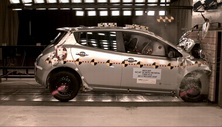
NHTSA frontal crash test
1 open NHTSA investigation into this model. Investigations come before recalls, so these are potential defects not yet covered by one.
Rated configuration: 2015 Nissan Leaf 5 HB FWD
Over 5 years this costs $8,000 less in fuel than an average new vehicle.