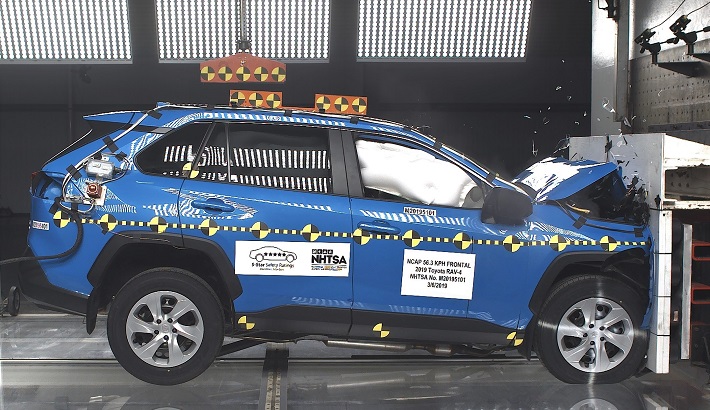
Open safety recalls, the components owners report failing most often, crash-test results and running costs for the 2021 Toyota RAV4, assembled from NHTSA and EPA records.
One specific car
Checking one Toyota RAV4?
Everything on this page applies to the model as a whole. Run its VIN to decode that exact car, its engine, trim, assembly plant and factory equipment, alongside these records.
Recalls and complaints are filed against a specific model year, so figures differ from one year to the next even within a single generation. See every Toyota RAV4 year.
NHTSA Recalls
Safety recalls
1 open
NHTSA lists 1 recall for this make, model and year. Recalls apply to the model, so some may already be fixed on this specific car. A dealer can confirm from the VIN.
AIR BAGS:SENSOR:OCCUPANT CLASSIFICATION20/12/2023
Issue: Toyota Motor Engineering & Manufacturing (Toyota) is recalling certain 2020-2021 Avalon, Avalon Hybrid, Corolla, Highlander, Highlander Hybrid, RAV4, RAV4 Hybrid, Lexus ES350, Lexus RX350, Lexus RX450H, 2021 Sienna Hybrid, Lexus ES250, 2020-2022 Camry, Camry Hybrid, and ES300H vehicles. A short circuit may develop in the Occupant Classification System (OCS) sensor, preventing the front passenger air bag from deploying.
Risk: An air bag that does not deploy during a crash increases the risk of injury.
Remedy: Dealers will inspect and replace the sensor as necessary, free of charge. Interim letters notifying owners of the safety risk were mailed in February 2024. Some final remedy owner letters were mailed October 31, 2024. Letters will continue to be mailed in phases through January 2026. Owners may contact Toyota customer service at 1-800-331-4331. Toyota's number for this recall is 23TB15/23TA15 Lexus 23LB03/23LA03.
I am reporting a serious safety concern involving the sunroof glass on my 2021 Toyota RAV4 Hybrid Limited AWD. On July 3, 2026, at approximately 37,350 miles, I was driving the vehicle when the entire sunroof glass suddenly and catastrophically shattered. There was no traffic around me, there was no debris in the roadway, I was not traveling under an overpass, and I am not aware of any impact or other event that could have caused the glass to break. The failure was completely unexpected. I heard a very, very loud sound, similar to a gunshot. Immediately afterward, the entire sunroof glass had shattered into small granules. A very small piece of shattered glass also flew off the vehicle. I was able to quickly close the interior sunroof visor, which fortunately prevented the majority of the shattered glass from falling into the passenger compartment and prevented injury. There was nevertheless some glass that fell into the roof liner. I immediately contacted my insurance company and the car was towed to my Toyota dealership. The sunroof was replaced with a Toyota original part and the replacement was paid by my insurance company. This incident created a significant safety hazard because the sunroof glass failed suddenly and violently while the vehicle was being driven. The extremely loud explosion-like sound and the sudden loss of the sunroof glass could cause a driver to lose control of the vehicle or could result in glass striking occupants. In this instance, I was fortunate that the visor was closed quickly and that there was no surrounding traffic. I believe NHTSA should investigate whether there is a defect or other safety-related problem with the sunroof glass or its installation in this vehicle, particularly if similar spontaneous breakage incidents have occurred in other Toyota RAV4 vehicles. I am reporting this incident because the glass appeared to fail spontaneously, without an apparent collision, road debris, overpass, or other external impact.
STEERING,POWER TRAIN,ENGINE09/13/2026
2021 Toyota RAV4 gas XXX Vehicle suddenly stopped while driving Busy roadway in [XXX] Wife and young children were passengers Dashboard displayed “ENGINE STOPPED” Dashboard displayed “STEERING POWER LOW” Police responded Police determined waiting for the insurance tow was unsafe Police arranged emergency towing Vehicle subsequently inspected by Beaver Toyota Dealer drove approximately 26 miles attempting to reproduce the issue No fault code/history found Problem could not be reproduced You remain concerned about a potentially recurring safety defect INFORMATION REDACTED PURSUANT TO THE FREEDOM OF INFORMATION ACT (FOIA), 5 U.S.C. 552(B)(6)
ELECTRICAL SYSTEM,UNKNOWN OR OTHER,ENGINE09/05/2026
I have a faulty coolant bypass valve on my 2021 Toyota RAV4. Every time I turn on the air conditioning the service engine required comes up on my notifications a known recall problem for Toyota RAV4’s of this year
POWER TRAIN,ELECTRICAL SYSTEM,ENGINE08/17/2026
2021 Toyota RAV4 (gas model) has experienced a sudden, unexpected engine stall/shutdown on a public road. The incident occurred while shifting into Drive after backing up in reverse. The engine immediately died without any prior dashboard warning lights or mechanical symptoms. The information screen displayed a message stating "Put Car in Park" or "Shift into Park." The vehicle safely restarted immediately after shifting back into Park and pressing the ignition button. This intermittent stall has happened three times under the exact same directional shifting conditions over the last 1.5 years, creating a high-risk scenario for a rear-end collision in active traffic. After previous incident (one year ago) when the engine stopped when shifting from reverse to drive, I took it to Toyota service. Dealership diagnostics could not previously replicate the issue due to its intermittent nature and the absence of a permanent check engine code. checked battery and performed health check.
SEATS08/10/2026
The driver’s seat adjustment mechanism failed and the seat became stuck, unable to move forward or backward. We initially went to a Toyota dealership and told them we believed the issue was a broken gear in the seat rail assembly. The dealership stated they needed to complete their own diagnostic assessment before proceeding, which would cost approximately $275 and add delay, despite already being told the likely cause. We instead took the vehicle to an independent mechanic, who confirmed the cause was a broken gear/synchronizing mechanism in the seat rail assembly. The mechanic confirmed that Toyota is the only source for this replacement part — it is not available from third-party or aftermarket suppliers — and has ordered the part directly from Toyota, at a cost of approximately $1,500, to install himself. This creates a safety risk because the driver is unable to adjust the seat position to reach the pedals and steering wheel properly, and cannot reposition the seat in the event of an emergency requiring rapid exit from the vehicle. Seating position also affects airbag deployment safety, since proper occupant positioning relative to the airbag is a factor in crash protection. There were no dashboard warning lights or error messages prior to the failure. The seat simply stopped moving on one side during normal, everyday adjustment. This appears to be a widespread and recurring issue rather than an isolated incident. Numerous other owners of 2019–2024 Toyota RAV4 vehicles have reported the identical failure — a broken gear in the seat rail mechanism — on Toyota owner forums and online community discussions, many describing the same high repair cost tied to the fact that only Toyota sells the necessary part. The vehicle is a 2021 Toyota RAV4 with approximately 56,000 miles at the time of failure. The component is available for inspection upon request.
VISIBILITY,SEATS07/31/2026
The contact owns a 2021 Toyota Rav4. The contact stated that while driving at an undisclosed speed, the front driver’s seat became stuck. No warning lights were illuminated. The failure reoccurred on several occasions. The contact stated that water was leaking into the vehicle from the front driver’s and passenger sides, causing puddles of water in the front driver’s and passenger’s seats with an abnormal odor. The contact stated that the leak was near the bolts and screws. The failure reoccurred on several occasions. The vehicle was taken to an independent mechanic, who advised that the water leak could not be repaired and that the condition was unsafe. The vehicle was not repaired. The vehicle was taken to a dealer where it was diagnosed and determined that the A/C system and several other unknown components needed to be replaced. The dealer stated that the vehicle was out of warranty. The vehicle was repaired. The manufacturer was notified of the failure and referred the contact to the NHTSA Hotline to report the failure. The failure mileage was unknown.
LATCHES/LOCKS/LINKAGES07/28/2026
The driver side door actuator will not work, car is only five years old. Door will not unlock from fob, door unlock button or app. Began with a few random instances of not unlocking then turned into never unlocking again. Would have to climb through the passenger side to manually unlock by pushing switch. Got the actuator replaced but now car will not allow opening from inside, have to climb out of passenger door. This is a major safety concern as being unable to open a door in an emergency can be life threatening. The problem was reproduced and repair quoted by dealership. Problem was also reproduced by local mechanic and part replaced by them. Component inspected by manufacturer. The only warning was it sometimes not working, this began a few months back around February 2026.
POWER TRAIN,UNKNOWN OR OTHER,ENGINE07/23/2026
My 2021 Toyota RAV4 began experiencing intermittent shuddering and vibration at low speeds around May 2026. The condition occurred while accelerating from a stop or at slow speeds and became more frequent over time. Because the problem was intermittent, the dealership was initially unable to duplicate it. Independent inspection later found dark transmission fluid containing metal debris, indicating internal transmission failure. I was informed the transmission requires replacement or rebuild. My vehicle has approximately 94,000 miles, which is well below the expected service life of a modern transmission. The symptoms are consistent with numerous reported complaints involving Toyota’s UA80 automatic transmission and torque converter. An unexpected loss of smooth power delivery or hesitation during acceleration creates a potential safety risk, particularly when entering traffic or crossing intersections. I am submitting this complaint so NHTSA can investigate as this is a very dangerous and concearning issue.
VEHICLE SPEED CONTROL,ENGINE07/23/2026
The contact owns a 2021 Toyota Rav4. The contact stated that while driving at approximately 30 MPH, the vehicle aggressively accelerated while the accelerator pedal was depressed. No warning light was illuminated. The vehicle was taken to a local dealer and remained with the dealer for additional diagnostic tests. The vehicle was not repaired. The manufacturer was made aware of the failure. The failure mileage was approximately 60,000.
UNKNOWN OR OTHER07/17/2026
The sunroof exploded spontaneously while I was driving. It sounded like a gunshot. There were no other vehicles around, so it wasn't caused by a stray rock. It was only 73 degrees, so I don't think it was heat related.
AIR BAGS07/04/2026
I have been unable to get my vehicle inspected and repaired by a dealer despite months of waiting and asking two different Toyota dealers to order the necessary part or parts. This recall has been in place for years. For several years I was told it was only being done in certain states and that New Mexico would be last on list due to climate. Probably six months ago the message changed from Toyota and it was now ok in every state. Only problem is still no parts according to dealer. Last contact was on June 2, 2026 with the second dealer to order part. No call back and no contact. First effort was in Santa Fe NM where car was purchased new in 2021at Toyota dealer. Last effort over a month ago was at Albuquerque Larry Miller Toyota. So safety recall for faulty air bag sensor on my wife's side of car has been in place about 900 days without parts to fix a potentially deadly problem. VERY DANGEROUS
UNKNOWN OR OTHER06/22/2026
What component or system failed, and is it available for inspection? The roof/water sealing system failed, allowing water to enter the vehicle interior. It is available for inspection upon request. How was safety put at risk? Water intrusion through the roof caused visible mold growth, interior deterioration, and a severe foul odor. The mold and contamination inside the vehicle is causing constant illness to the occupant, creating a serious ongoing health and safety hazard. Has the problem been reproduced or confirmed by a dealer or service center? The vehicle was brought to a service center for inspection, however they refused to inspect it. The problem has not been formally confirmed. Has the vehicle been inspected by the manufacturer, police, insurance, or others? The vehicle was taken in for inspection but the dealer/service center declined to inspect it. No manufacturer, police, or insurance inspection has taken place. Were there warning lamps, messages, or symptoms prior to failure? When did they first appear? No warning lamps or messages appeared. The symptoms that developed include: Water entering through the roof Visible mold growth Interior deterioration Severe foul odor described as "rotten rat" smell Occupant experiencing constant illness due to exposure