Open safety recalls, the components owners report failing most often, crash-test results and running costs for the 2019 Toyota Yaris, assembled from NHTSA and EPA records.
Everything on this page applies to the model as a whole. Run its VIN to decode that exact car, its engine, trim, assembly plant and factory equipment, alongside these records.
Open a VIN recordRecalls and complaints are filed against a specific model year, so figures differ from one year to the next even within a single generation. See every Toyota Yaris year.
NHTSA lists 3 recalls for this make, model and year. Recalls apply to the model, so some may already be fixed on this specific car. A dealer can confirm from the VIN.
Issue: Southeast Toyota Distributors, LLC (SET) is recalling certain 2017-2019 Toyota Camry, Corolla, Rav4, Sienna, and Yaris iA vehicles equipped with factory-installed floor mats. The load carrying capacity modification label may be incorrect. As such, these vehicles fail to comply with the requirements of Federal Motor Vehicle Safety Standard (FMVSS) number 110, "Tire Selection and Rims."
Risk: An incorrect label may lead to unintentionally overloading the vehicle, increasing the risk of a crash.
Remedy: SET will notify owners and provide a corrected label for placement over the inaccurate label, free of charge. The recall began August 23, 2019. Owners may contact Toyota customer service at 1-888-270-9371. SET's number for this recall is SET19A.
Campaign 19V503000
Issue: Toyota Motor Engineering & Manufacturing (Toyota) is recalling certain 2019-2020 Yaris, Yaris Hatchback, and Yaris Sedan vehicles. An impeller within the low-pressure fuel pump may crack and deform, potentially causing the fuel pump to fail.
Risk: A fuel pump failure may cause an engine stall, increasing the risk of a crash.
Remedy: Dealers will replace the low-pressure fuel pump assembly, free of charge. Owner notification letters were mailed December 30, 2021. Owners may contact Toyota customer service at 1-800-331-4331. Toyota's numbers for this recall are 21TB05 and 21TA05.
Campaign 21V617000
Issue: Gulf States Toyota (GST) is recalling certain 2019 C-HR, 4Runner, Avalon, Avalon Hybrid, Camry, Camry Hybrid, Highlander, Land Cruiser, Prius, RAV4, Sequoia, Tacoma, Sienna, Tundra and Yaris vehicles. The text on the load capacity label may become illegible. As such, these vehicles fail to comply with the requirements of Federal Motor Vehicle Safety Standard (FMVSS) number 110, "Tire Selection and Rims."
Risk: If the driver cannot read the label, they may unknowingly overload the vehicle, increasing the risk of a crash.
Remedy: GST will notify owners, and dealers will provide corrected load carrying capacity modification labels, free of charge. The recall began May 24, 2019. Owners may contact GST customer service at 1-800-444-1074. GST's number for this recall is 19R1.
Campaign 19V244000
Over 5 years this costs $2,250 less in fuel than an average new vehicle.
The parts named most often across 26 owner complaints filed with NHTSA for this make, model and year.
1 fire
Complaints are self-reported and skew toward problems people find alarming, so read this as where to look rather than as a defect rate.
Vehicle has safety recall, vehicle may stall at high speed, Toyota dealership replace fuel pump after replacements check engine light came on same day, and after few thousand miles light also came on , never fix the problem, now they charged me $280.00 to do the diagnostic check engine light even though that i purchased extended warranty for 125,000 miles and they also want to charge me $930.00 for engine de carburetor and test again…Thanks
The contact owned a 2019 Toyota Yaris. The contact stated that while his wife was reversing out of the driveway, the vehicle unintendedly accelerated although the brake pedal was depressed. The vehicle crashed into a tree and the neighbor's house. The paramedics, fire department, and police arrived and created a report. The contact's wife suffered bruising and body aches upon impact. The contact stated that the vehicle was taken to an impound lot. The vehicle was deemed a total loss by the insurance company. The vehicle was not diagnosed nor repaired. The manufacturer was not made aware of the failure. The approximate failure mileage was 40,000.
The contact owned a 2019 Toyota Yaris. The contact stated that after his wife had arrived at her destination, a short time later she was made aware that the vehicle was on fire. Upon arriving on the scene, the contact's wife observed a fire originating in the engine compartment. Local emergency services were called and were able to extinguish the fire. A police and fire report was filed, but no injuries were reported. The vehicle was towed to a tow yard and deemed a total loss. The manufacturer was not notified of the failure. The failure mileage was 72,000.
Car driving with no one in front and brake assist went off on own. Also car driving and electrical system in car shut down and lost control of car. Then all dashboard lights came on, was able to regain control and pull in parking lot. Shut car off. Hooked up ODB. No codes. Then started car and ran fine. Had burning electrical smell.
2019 TOYOTA YARIS. CONSUMER WRITES IN REGARD TO VEHICLE BEING HACKED. THE CONSUMER BELIEVES IN HIS OPINION SOMEONE REMOTELY SHUTDOWN OR DISABLED THE VEHICLE WHILE DRIVING 65MPH ON THE INTERSTATE. UPDATE 06/20/2023- CONSUMER IS REQUESTING PETITON AND HEARING. PETITION AND HEARING REQUEST DOCUMENT MAILED IN.
2019 TOYOTA YARIS. CONSUMER WRITES IN REGARD TO ENGINE FAILURE.
2019 TOYOTA YARIS. CONSUMER WRITES IN REGARD TO ENGINE FAILURE. THE CONSUMER STATED THE VEHICLE SHUT OFF WHILE BEING DRIVEN. THE VEHICLE DROVE ROUGH, ENGINE NOISES, AND EXPERIENCED ACCELERATION DELAYS. THE DEALER STATED THAT ALL THE LINES AND GDI ASSOCIATED WITH THE FUEL PUMP HAD CARBON BUILD UP. THE GDI LINS WERE FLUSHED. WHICH DID NOT REPAIR THE VEHICLE. THE DEALER ADVISED THE CAUSE OF THE PROBLEM WAS UNKNOWN. THE VEHICLE WOULD NEED TO BE FLUSHED EVERY SIX MONTHS, AT THE OWNER'S EXPENSE OF 1200.00. THE CONSUMER STATED THIS WAS UNREASONABLE. THE DEALER ALSO ADVISED TO ACCELERATE THE VEHICLE 2 OR 3 TIMES A WEEK AT A HIGH SPEED RATE, IN ORDER TO FORCE OUT THE BUILD UP. THE CONSUMER BELIEVED THE VEHICLE WAS A LEMON.
I got new tires and took the car for an alignment. I am constantly having to slightly correct my steering wheel. One to three degrees to the left and right at any speed the entire time I am driving. It was setup for the diagnostic test and the technician came back in less than five minutes. To tell me that there is nothing wrong with my alignment and everything was at factory spec. So I told him to drive it and tell me that there is nothing wrong with my car. He came back looking shocked and said that was weird. Like driving on wet glass. So he started to ask me questions. My answers to the question were. I am the original owner, never been in an accident with the car or hit debris of any kind. Tires are brand new, no check engine or warning lights. Diagnostic scanner to the OBD port came back with no problems. Car had 25,000 miles on it at the time. I've been told it could be any of eight or nine problems or a combination of a few. Electric power steering, traction control, ABS, Tire pressure monitor, steering angle sensor, tie rod, ball joints, suspension. My question is, how does this happen with regular service and no warning detection system on board or service equipment finding anything ???
The contact owns a 2019 Toyota Yaris. The contact initially stated that multiple attempts were needed to start his vehicle. When the vehicle would start, the transmission would hesitate upon the depression of the accelerator pedal with several unknown warning lights illuminated. Upon investigation underneath the hood, the contact discovered sticks and chewed wiring which he linked to squirrels. Since the initial discovery, the contact had seen squirrels entering and leaving the engine compartment on two separate occasions. The dealer had been notified of the failure but offered no assistance. The manufacturer was also notified of the failure and provided a case number. The contact ordered the parts to replace the wiring harness and air filter cover however, the vehicle was not yet repaired. The failure mileage was approximately 14,700.
I went to the dealership to get my safety recall fixed and i was informed that my safety recall cannot be fixed. This is a problem because I am risking my life every time I drive this car I want to know if getting a lawyer to resolve this issue is the best solution to getting this problem solved
Recall for dangerous issue (risk of crash due to faulty fuel pump) has been unresolved since mid 2021. Have contacted several Toyota dealerships who have said they aren’t able to repair fuel pump since a solution for recall hasn’t been issued yet. Contacted Toyota corporate to ask for rental car until a repair is confirmed and they stated they cannot guarantee a rental will be reimbursed and have no timeline for fuel pump solution. Have been unable to drive my car on highway for six months as it feels unsafe.
2019 TOYOTA YARIS. CONSUMER WRITES IN REGARDS TO ISSUE WITH THE BATTERY. In early 2000 the battery went dead, and the car could not even be removed from the garage. Called the dealership and they were kind enough to send a tow truck, and the driver was able to get car on the truck and took it directly to the dealership. It was examined and a new battery was put in at no cost to me. TS THE CONSUMER STATED THE BATTERY WAS REPAIRED. THE VEHICLE WAS ON A RECALL LIST FOR ANOTHER FAILURE BUT, THERE WAS NO REMEDY.
Showing 12 of 26 complaints.

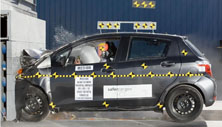
NHTSA frontal crash test
1 open NHTSA investigation into this model. Investigations come before recalls, so these are potential defects not yet covered by one.
Rated configuration: 2019 Toyota Yaris 5 HB FWD